Small Business Marketing Ideas for 2026: Proven Strategies to Boost Growth
Explore the best Small Business Marketing Ideas for 2026, including online marketing, how to promote your business locally, and the best marketing strategies with clear KPI tracking.

Julia

Small business owners in 2026 face rising costs, high competition, and more demanding customers, so their small business marketing must be lean, focused, and measurable. Marketing ideas for small businesses now center on low-cost digital channels, strong community presence, and data-driven decisions rather than guesswork. A clear marketing plan with realistic goals and tracked KPI is no longer optional; it is the only way to understand what truly works.
Online Marketing for Small Business
Online marketing for small businesses in 2026 is built around three pillars: search, content, and social. Search engine optimization (SEO) and answer engine optimization (AEO) help your site appear when people ask questions on Google or via voice assistants, bringing in free, high-intent traffic. Publishing useful blog posts, FAQs, and guides around your offers positions your brand as a trusted expert and supports long-term organic growth.
Short-form video is now one of the most powerful Small Business Marketing Ideas, especially on TikTok, Instagram Reels, and YouTube Shorts. Simple 20–60 second clips showing how products work, behind-the-scenes moments, or quick tips can attract thousands of views without paid ads. You can then repurpose these videos into ads, website content, and email embeds to maximize each asset.
Social media marketing ideas for small businesses should prioritize consistency over being everywhere. Pick two or three platforms where your audience actually spends time, then post regularly, reply to comments, and use Stories, polls, and question stickers to get direct feedback. User-generated content (UGC) campaigns, such as hashtag challenges, review requests, or photo contests — help turn customers into promoters and give you authentic content to reshare.
Email remains one of the highest-ROI channels for small business marketing, and 2026 tools make it easier than ever. AI-powered platforms can segment subscribers, optimize send times, and generate subject lines, meaning small teams can run advanced campaigns without a dedicated marketer. Use welcome sequences, abandoned-cart flows, and reactivation campaigns to automatically nurture leads and bring back inactive buyers. Tie every email flow to measurable KPI like open rate, click-through rate, and revenue per subscriber for continuous improvement.
Another core element of online marketing for small business is using simple landing pages focused on one goal: booking a call, capturing an email, or selling a featured product. These pages should include clear benefits, social proof, and one strong call to action, making it easy for visitors to act. Over time, A/B testing headlines, images, and offers can significantly increase conversion rates, even with modest traffic.

How to Promote Your Business Locally
If you ask how to promote your business locally in 2026, start with your online local presence. Claim and fully optimize your Google Business Profile with photos, accurate hours, services, and regular posts so you appear in map results and “near me” searches. Encourage customers to leave honest reviews and always respond politely: positive review volume and responses directly influence local visibility and trust.
Next, focus on local marketing partnerships and events. Collaborate with complementary businesses (for example, a café with a bookstore or a gym with a healthy food brand) for joint promos, bundles, or pop-up events. These cross-promotions let you access each other’s audiences with almost no media budget. Local sponsorships, like supporting a school event or sports team, also create goodwill and long-term brand recall within your community.
Offline visibility still matters:
- flyers in targeted locations,
- business cards with QR codes,
- branded packaging,
- vehicle wraps.
Combine these with geotargeted social ads or organic posts using local hashtags to reinforce your presence from both offline and online angles. For many small businesses, the winning formula is a hybrid approach where in-person touchpoints lead people to follow your online channels and join your email list. Community-building is one of the strongest Small Business Marketing Ideas at the local level. Consider running small workshops, free consultations, or live demos, then capturing attendee emails or social follows for ongoing communication. Over time you can transform this group into a loyal community via newsletters or small private groups where you share exclusive news, tips, and early access offers.
If you struggle with small business marketing challenges such as low local awareness or limited budget, use this step-by-step approach: clarify your target neighborhood or segment, choose two to three core local tactics (Google Business Profile, one recurring event, one partnership), and track outcomes monthly. This keeps your local efforts focused and easy to refine instead of scattered.

Best Marketing Strategies
The best marketing strategies for small businesses in 2026 share three traits: they are measurable, customer-centric, and realistic for a small team to execute. Referral and loyalty programs remain top marketing ideas for small business because they leverage existing happy customers instead of expensive cold traffic. Simple rewards: discounts, free products, or early access, can motivate word-of-mouth and repeat purchases at a relatively low cost.
Personalization is now expected, not a luxury. Thanks to widespread AI tools, even very small businesses can show different offers based on customer behavior, tailor email content, and suggest relevant products. Hyper-personalization, when done transparently and with respect for privacy, significantly improves engagement and loyalty. It should be planned as a core part of your marketing plan, not a one-time experiment.
Working with key opinion leaders and micro-influencers is another proven path, especially in niche markets. Rather than paying huge fees to celebrity influencers, small businesses often get better results by partnering with smaller creators whose audiences closely match their ideal customers. These collaborations can involve product swaps, affiliate deals, co-created content, or joint events.
For owners still exploring small business ideas, it helps to study examples of models that adapt well to 2026 trends such as subscription services, hybrid online: offline concepts, and expertise-based businesses. Aligning the business model itself with sustainable demand and digital channels will make all subsequent marketing efforts more efficient.
Below is an overview table capturing core Small Business Marketing Ideas and how they support growth in 2026:
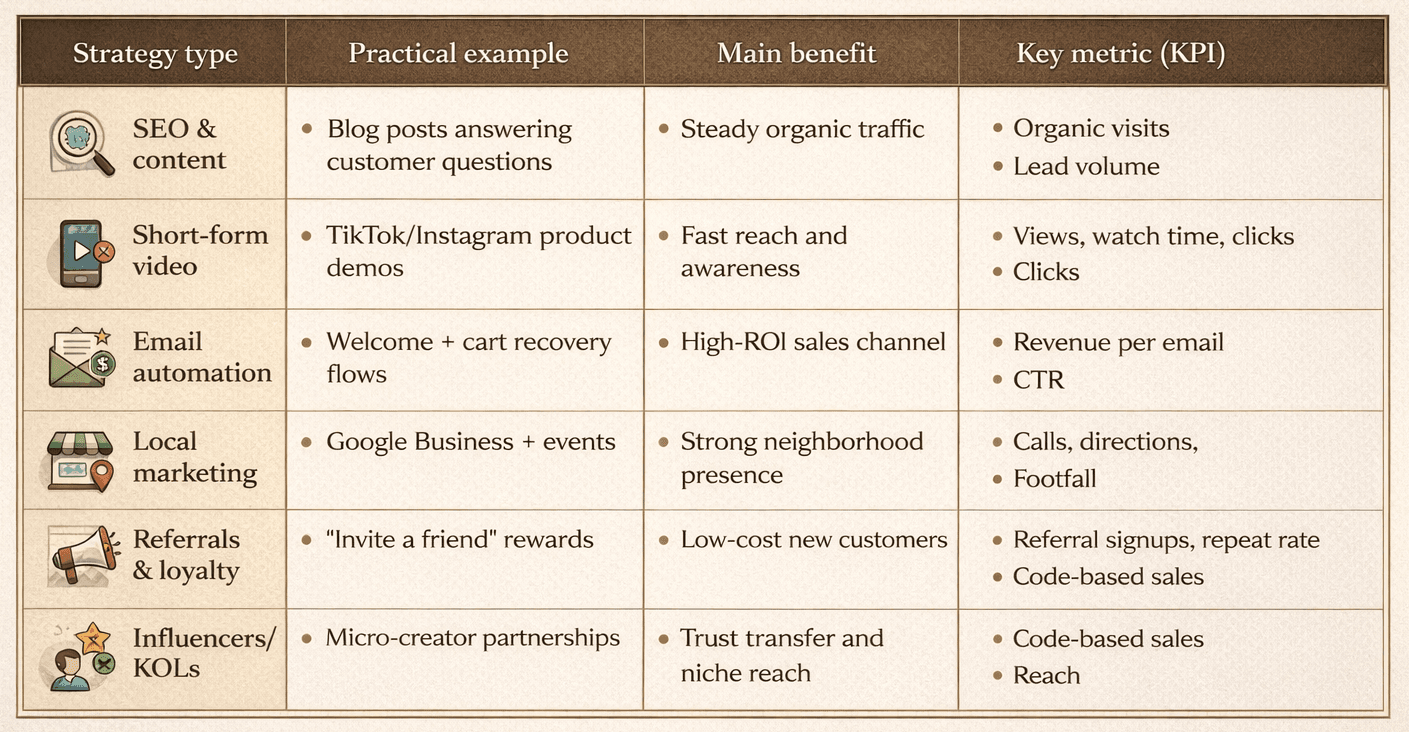
To truly call these the best marketing strategies, they must be tracked against clear KPI such as customer acquisition cost, lifetime value, conversion rate, and retention. Without tracking, it is impossible to know which Small Business Marketing Ideas deserve more budget and which should be cut.
Turning Ideas into an Actionable Marketing Plan
A key mistake many owners make is collecting many Small Business Marketing Ideas but never turning them into a disciplined plan. A simple one-page marketing plan for 2026 can include your target audience, 3–5 main channels, core messages, monthly budget, and 4–6 primary KPI to track. This lightweight document keeps everyone focused and makes it easier to evaluate new tactics against existing priorities.
Another practical way to strengthen your Small Business Marketing Ideas for 2026 is to document them in a simple roadmap with clear goals, channels, budgets, and success metrics tied to specific KPI. This helps you avoid chasing trends and instead double down on what actually works for your audience. Review this roadmap monthly, remove tactics that do not move your numbers, and reallocate time and money to the ones that do. Combined with regular insight from resources on small business ideas and small business marketing challenges, this keeps your marketing plan focused, realistic, and aligned with real-world constraints facing small business owners in 2026.
When evaluating tools, start small: free or low-cost solutions for email, social media scheduling, and analytics can cover most needs. From there, add only what directly supports your chosen strategies, such as SEO software, review management tools, or AI content helpers, so your stack stays manageable.
Finally, schedule quarterly reviews of your small business marketing performance: compare results to your KPI, identify 2–3 winning tactics, and deliberately test one new Small Business Marketing Idea at a time instead of overloading your team. This experimental but structured approach helps you adapt to 2026 trends without losing focus.
Ready to put these Small Business Marketing Ideas into practice? Create a free business account on Loca today: the smart, affordable solution for tracking KPI, overcoming small business marketing challenges, and executing the best Small Business Marketing Ideas in one place.